

Browse Jobs in Canada
Find your next design role at companies that value creative talent
Showing 4 jobs
Product Designer
Remote (🇨🇦 Canada)
Jobgether Remote (🇨🇦 Canada)
You will design user flows, wireframes, and high-fidelity interfaces while contributing to a scalable design system. You will also partner with product managers and engineers to translate complex workflows into intuitive digital experiences.

Senior UI Designer - AI Trainer
Remote (🇨🇦 Canada)
Dataannotation Remote (🇨🇦 Canada)
Review and critique AI-generated UI/UX designs and mockups to improve model performance. Help train AI models to better understand aesthetic quality and user-centered design principles.
Sr. Graphic Designer
Remote (🇨🇦 Toronto, Ontario, Canada)
Propelis Remote (🇨🇦 Toronto, Ontario, Canada)
Lead the design and development of high-impact retail and point-of-sale materials while ensuring brand consistency and regulatory compliance. Collaborate with the studio team to manage multiple projects, mentor junior designers, and maintain marketing production processes.

Senior Product Designer
Remote (🇨🇦 Vancouver, British Columbia, Canada)
Aligned Remote (🇨🇦 Vancouver, British Columbia, Canada)
The Senior Product Designer will lead end-to-end design processes from discovery to delivery while acting as the primary design voice for their Squad. They will partner with clients and internal teams to build intuitive product experiences, maintain design systems, and ensure high-fidelity execution.
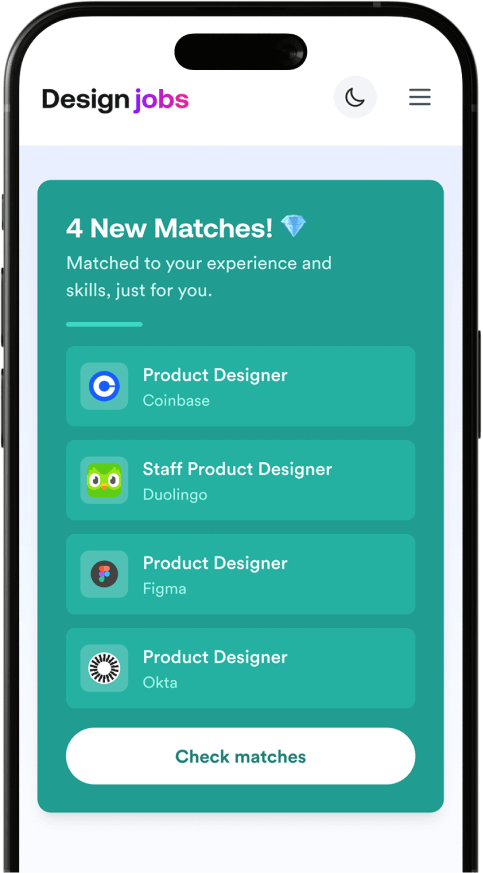
Stop scrolling. Get matched with roles that fit you. 💎
Upload your resume and let the right roles find you
How design hiring is changing in 2026
Design hiring has changed. Craft alone is no longer enough. Top teams now expect designers to ship live code, work alongside AI tools, and prototype fast.
Whether you are a Product Designer shipping features or a Graphic Designer guiding AI-generated visuals, the strongest roles reward deep craft and tool fluency together.
DesignJobs lists roles from companies leading the shift, including OpenAI, Anthropic, Vercel, and Linear. Spend less time searching, more time on the work.
Across all roles, the biggest differentiator is technical literacy. For Product Designers, this means "vibe coding" and functional prototyping. For Brand Designers, it's managing generative identity systems. The ability to leverage AI to move faster while maintaining human-centered quality is what separates top candidates today.
The design world is increasingly distributed, though many AI leaders now favor hybrid hubs. While companies like Figma, Notion, and Anthropic often prioritize collaboration in SF or London, we also feature truly remote-first teams like PostHog and Supabase. Use our "Remote Only" toggle on the main jobs page to filter for positions that allow you to work from anywhere.
While not a strict requirement for every role, it is becoming the standard for Design Engineering and high-growth Product roles. Being able to express design intent through code allows you to iterate at the speed of thought. We recommend designers bridge the gap using tools like Cursor, v0, and Replit to stay competitive.
Our AI Job Matcher analyzes your specific skill set, portfolio style, and career goals to surface roles you might miss with a traditional keyword search. It is designed to understand the nuance of your "design vibe" and match it with the culture of hiring teams at companies like Google and Perplexity.
Absolutely. In 2026, we are moving beyond "chatbots" to autonomous agents. Agentic UX involves designing systems that take action on behalf of the user. Your portfolio should demonstrate how you handle agentic trust, error states in autonomous flows, and "human-in-the-loop" verification points.
Yes! We feature a wide range of entry-level and junior design jobs across all categories. While the market is competitive, companies are actively seeking early-career designers who demonstrate technical agency and a willingness to master AI-assisted workflows.
We prioritize listings with transparent salary data. In 2026, compensation for roles like Design Engineering has seen significant growth due to the scarcity of hybrid "design-dev" talent. For deeper insights, check out our 2026 Design Salary Guide.
In 2026, the term Product Orchestrator refers to senior designers who direct AI-integrated systems rather than handcrafting every screen. While a Senior Product Designer focuses on the craft and technical agency, an Orchestrator focuses on cross-functional strategy, data logic, and aligning generative outcomes with business ROI.
Yes. High-growth companies like OpenAI look for portfolios that prove you can design for safety. This means showing how users can edit, override, or approve AI-generated outputs, ensuring the human remains the final decision-maker in the workflow.