

Browse Jobs in Bordeaux, France
Find your next design role at companies that value creative talent
Showing 7 jobs

Founding Product Designer
Remote (🇫🇷 Bordeaux, Gironde, France)
Titane Intelligence Remote (🇫🇷 Bordeaux, Gironde, France)
Redesign the La Forge platform experience to make customer value clear, emphasize actionable business results, and shorten the time from onboarding to first value. Conduct user research, improve documentation for human and AI readers, and collaborate with the Founding Product Engineer from prototype through production.

Product Designer - F/H
Remote (🇫🇷 Bordeaux, Gironde, France)
Niji Remote (🇫🇷 Bordeaux, Gironde, France)
Lead design for an internal industrial product, partnering with product owners, developers, and subject-matter experts to understand users and their working conditions. Conduct research, design and document user journeys and interfaces, test solutions, support UX/UI acceptance and prioritization, and use data and AI to improve product quality and productivity.
Product Designer - F/H
🇫🇷 Bordeaux, Gironde, France
Niji 🇫🇷 Bordeaux, Gironde, France
The Product Designer acts as the primary designer for internal business products, collaborating with Product Owners and technical teams to deliver high-quality UX/UI solutions. They are responsible for conducting user research, creating prototypes, and ensuring designs meet the specific needs of industrial operators and engineers.
Product Designer Senior H/F
🇫🇷 Bordeaux, Gironde, France
Nexton 🇫🇷 Bordeaux, Gironde, France
The Senior Product Designer will lead and mentor a design team while collaborating with Product Managers to define the design roadmap. They are responsible for conducting user research, overseeing interface consistency, and ensuring an iterative design process from prototyping to final delivery.
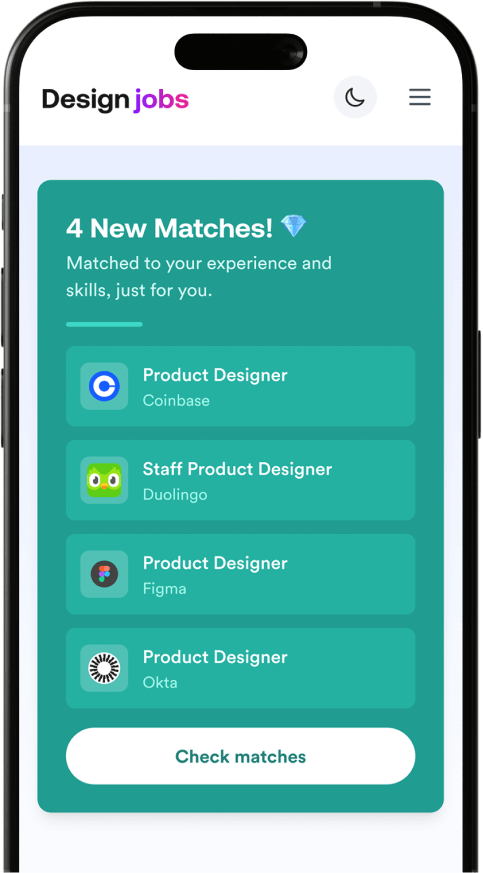
Stop scrolling. Get matched with roles that fit you. 💎
Upload your resume and let the right roles find you

Product Designer Senior H/F
🇫🇷 Bordeaux, Gironde, France
Nexton 🇫🇷 Bordeaux, Gironde, France
Lead and develop a UX/UI design team, conduct user research, and define the design roadmap in close collaboration with Product Managers. Analyze user feedback, recommend strategic improvements, maintain visual and usability consistency across interfaces, and oversee iterative design from rapid prototyping through final mockups.

Product Designer Senior - Industrie & B2E F/H
🇫🇷 Bordeaux, Gironde, France
Onepoint 🇫🇷 Bordeaux, Gironde, France
You will design digital tools for industrial teams by conducting user research, creating wireframes, and producing high-fidelity prototypes. You will also act as the UX/UI lead within an agile team, ensuring product performance and continuous improvement through user testing and data analysis.

Product Designer Fullcycle
🇫🇷 Bordeaux, Gironde, France
Wanteeed 🇫🇷 Bordeaux, Gironde, France
Own product projects from discovery through delivery, including framing user and business problems, involving developers early, and communicating directly with stakeholders. Guide iterative delivery, prioritization, and analysis of results, taking responsibility for project impact.
How design hiring is changing in 2026
Design hiring has changed. Craft alone is no longer enough. Top teams now expect designers to ship live code, work alongside AI tools, and prototype fast.
Whether you are a Product Designer shipping features or a Graphic Designer guiding AI-generated visuals, the strongest roles reward deep craft and tool fluency together.
DesignJobs lists roles from companies leading the shift, including OpenAI, Anthropic, Vercel, and Linear. Spend less time searching, more time on the work.
Across all roles, the biggest differentiator is technical literacy. For Product Designers, this means "vibe coding" and functional prototyping. For Brand Designers, it's managing generative identity systems. The ability to leverage AI to move faster while maintaining human-centered quality is what separates top candidates today.
The design world is increasingly distributed, though many AI leaders now favor hybrid hubs. While companies like Figma, Notion, and Anthropic often prioritize collaboration in SF or London, we also feature truly remote-first teams like PostHog and Supabase. Use our "Remote Only" toggle on the main jobs page to filter for positions that allow you to work from anywhere.
While not a strict requirement for every role, it is becoming the standard for Design Engineering and high-growth Product roles. Being able to express design intent through code allows you to iterate at the speed of thought. We recommend designers bridge the gap using tools like Cursor, v0, and Replit to stay competitive.
Our AI Job Matcher analyzes your specific skill set, portfolio style, and career goals to surface roles you might miss with a traditional keyword search. It is designed to understand the nuance of your "design vibe" and match it with the culture of hiring teams at companies like Google and Perplexity.
Absolutely. In 2026, we are moving beyond "chatbots" to autonomous agents. Agentic UX involves designing systems that take action on behalf of the user. Your portfolio should demonstrate how you handle agentic trust, error states in autonomous flows, and "human-in-the-loop" verification points.
Yes! We feature a wide range of entry-level and junior design jobs across all categories. While the market is competitive, companies are actively seeking early-career designers who demonstrate technical agency and a willingness to master AI-assisted workflows.
We prioritize listings with transparent salary data. In 2026, compensation for roles like Design Engineering has seen significant growth due to the scarcity of hybrid "design-dev" talent. For deeper insights, check out our 2026 Design Salary Guide.
In 2026, the term Product Orchestrator refers to senior designers who direct AI-integrated systems rather than handcrafting every screen. While a Senior Product Designer focuses on the craft and technical agency, an Orchestrator focuses on cross-functional strategy, data logic, and aligning generative outcomes with business ROI.
Yes. High-growth companies like OpenAI look for portfolios that prove you can design for safety. This means showing how users can edit, override, or approve AI-generated outputs, ensuring the human remains the final decision-maker in the workflow.